扫描二维码
关注北京大学汇丰金融研究院官方微信/微博

PKU Financial Review:Professor Currie, your recent research has delved into how socioeconomic status (SES) in early life persistently influences later health and cognitive development. Given your frequent focus on environmental factors (e.g., air quality, neighborhood resources) and the long-term effects of early interventions, what do you consider the "most critical yet most policy-overlooked" intermediate mechanism driving health inequalities? In other words, how can we more effectively identify and intervene on early-life exposures that are not yet fully manifest but exert a multiplier effect on long-term health trajectories?
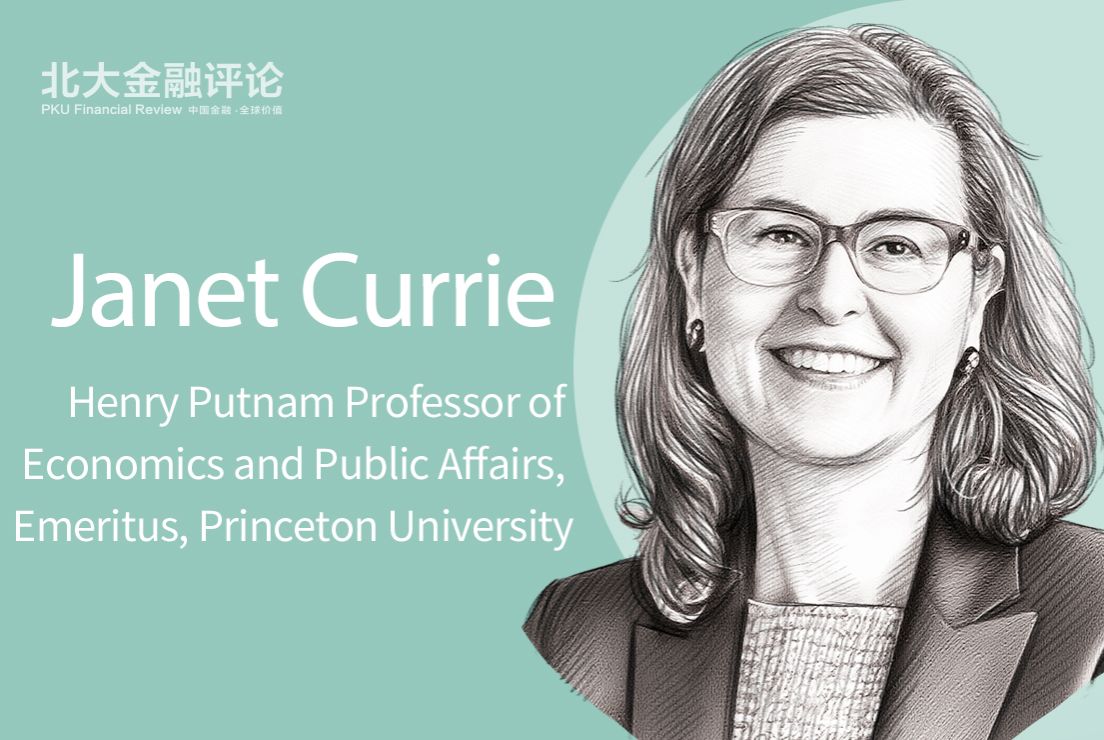
Janet Currie:Given the importance of environmental factors, one of the most critical yet policy-overlooked factors is the fact that poorer (or minority, or less educated) people tend to live in areas that expose them to more of all kinds of hazards from air pollution, to noise, to crime, to lack of social infrastructure. We currently know little about how these multiple different types of exposure interact. Thinking about it from a planning perspective, there has been relatively little research into the extent that policy can improve outcomes for disadvantaged people by improving the areas where they live. For example, instead of having homes and schools next to busy highways, it might be possible to buffer the highways with green space. Similarly, targeted and consistent reductions in crime along with programs to build social infrastructure such as boys and girls clubs might also improve long-term outcomes.
PKU Financial Review: Growing evidence suggests that health outcomes depend not only on resource access but also on family decision-making quality, information availability, and "behavioral inertia." In your view, what key insights does integrating behavioral economics or psychology into traditional health economics models offer for understanding and designing more effective public health interventions—particularly insights that differ from purely price- or supply-side approaches? Have any unexpected findings emerged from this interdisciplinary work, especially in promoting early health behavior change among vulnerable populations?
Janet Currie :We all know from our own experience that it can be difficult to change habitual ways of doing things even when we learn that it is in our own best interest. Behavioral economics suggests that things like default rules can help. e.g. if the default is that all children get vaccinated at school unless parents opt out, then more children will be vaccinated than if the default is that parents need to sign up their children. We also know that learning new information works best if the information can be delivered in small doses that are repeated and reinforced rather than in one helicopter drop. This may be one reason why home visiting programs are often successful -- the visitor meets people where they are (in their own home) and provides manageable amounts of information that build to meaningful change over time. This model also exploits another behavioral finding which is that working with a partner is more motivational than working alone. Hence, I think the behavioral work can help us to understand why some types of interventions are more successful than others in effecting behavioral change.
PKU Financial Review: Given your deep research on U.S. health inequalities, many emerging and developing economies face health challenges amid rapid urbanization and structural transformation. If you could offer one core policy recommendation to countries grappling with large health disparities, based on your research on the returns to early-life investments, what would it be? Which fundamental health economics principles do you consider universally applicable in bridging income-related health gaps?
Janet Currie :My core policy recommendation is to remember that investing in children has high returns, and to invest public funds accordingly. These returns are often realized over a long time horizon, while policy makers are often under pressure to produce results quickly, which is one reason why society underinvests in children. Moreover, parents are often budget constrained in a way that prevents them from being able to undertake investments in their children's health and education which would have large payoffs for society. Governments need to find ways to relieve these constraints so that the next generation can thrive.
友情链接:
联系我们:
扫描二维码
关注北京大学汇丰金融研究院官方微信/微博
 微信公众号
微信公众号 微博
微博
© 2018版权属北大汇丰商学院所有
ICP备案编号:粤ICP备12081285号